
Beyond Factory Rules: Why Standard Sampling Plans may be a Compliance Risk in GxP Data Migrations
Migrating electronic Trial Master File (eTMF) records from legacy software to modern cloud architectures involves transferring regulatory evidence supporting clinical trial integrity and Good Clinical Practice (GCP) compliance. Converting thousands of clinical records across non-identical schemas requires reformatting dates, adjusting field lengths, and remapping system objects. These transformations carry a risk of data truncation, field corruption, or metadata loss as just some data integrity failure examples.
To comply with ALCOA++ data integrity principles, organizations must prove that migrated data (target datasets) form a complete and accurate copy of the original data and records, and can be relied on in the new architecture or software solution. Because 100% manual inspection of large enterprise datasets is rarely feasible, validation teams rely on statistical sampling. However, applying standard manufacturing sampling plans to GxP data transfers can introduce compliance risks.
The Sampling Trap: Accepting Defects by Design
When evaluating large datasets, project teams often default to standard sampling plans. While effective on physical manufacturing lines, applying these standards to GxP data migrations can introduce data integrity issues and ultimately compliance gaps.
Limitations of Traditional Sampling Methods
- The n+1 Heuristic: Originating as an agricultural rule of thumb, (Muralimanohar & Jaianand, 2011), this formula relies on a single static Operating Characteristic (OC) curve. It does not scale proportionally with lot size, under-inspecting large datasets while over-inspecting small batches. It lacks statistical validity and may be viewed by regulators as statistically weak and not providing adequate statistical confidence.
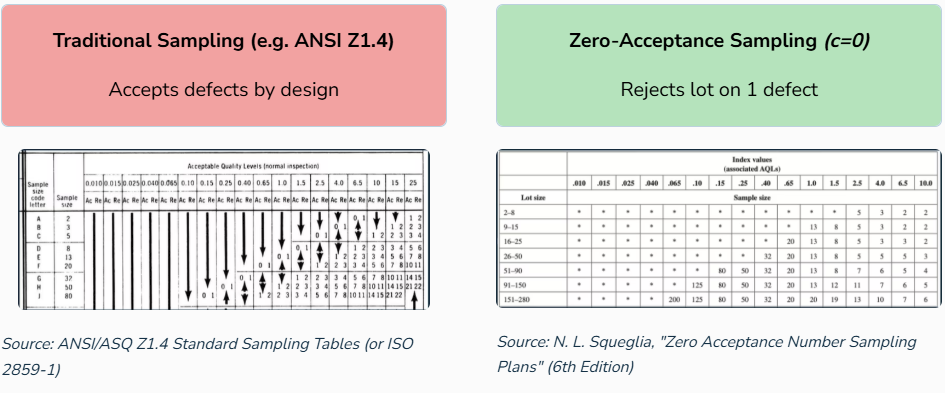
- Attribute Manufacturing Standards (ANSI Z1.4 / ISO 2859-1): Designed for high-volume manufacturing, standard attribute plans use Acceptable Quality Level (AQL) thresholds that permit a defined percentage of defects per lot to pass inspection.
In physical manufacturing, minor cosmetic defect allowances may be acceptable. In a GxP data pipeline where thousands or millions of records may be undergoing migration, accepting defective records creates data integrity and compliance exposure.
Transformation scripts execute repetitive logic across entire record categories. A single sample defect likely indicates a systemic error in the underlying code. For example, if a parent object, such as a Study, Country, or Site, is corrupted, downstream child documents may become unlinked or unretrievable. Accepting defective data risks introducing orphan records, misclassified metadata, and incomplete audit trails in the target system and the records in the new production environment may not be fit for purpose.
The Solution: Zero-Acceptance Sampling (c=0)
To establish statistical confidence, GxP data migrations can leverage Nicholas L. Squeglia’s Zero-Acceptance Sampling (c=0) framework.
The Three Pillars of c=0 Sampling
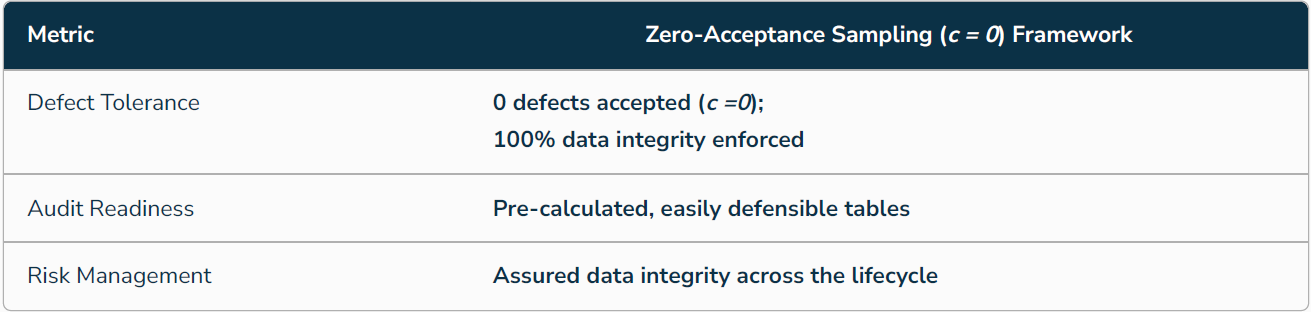
- Zero Defects Permitted (c=0): A dataset passes inspection only if zero non-conformances are identified in the sample. A single defect is considered a reject, and requires root-cause investigation.
- Focus on Consumer Risk: Traditional plans protect producer risk by permitting defect tolerances. c=0 sampling focuses on Limiting Quality, prioritizing patient safety.
- Audit-Readiness: Pre-calculated c=0 tables allow validation teams to select and document statistically sound sample sizes.
Risk-Proportionate Verification
In alignment with FDA Computer Software Assurance (CSA) guidance and GAMP 5 principles, verification effort must be proportionate to risk. Rather than applying uniform sampling across all data entities, teams perform an object-level risk assessment to categorize data by clinical safety, regulatory, and operational impact.
Criticality tiers dictate underlying quality parameters without altering the zero-acceptance rule. High-risk structural objects, such as study hierarchies, active clinical documents, and site personnel records, require larger sample sizes for statistical confidence. Lower-risk supporting objects (such as reference lists or auxiliary profile attributes) use smaller sample sizes, optimizing inspection effort while maintaining zero-acceptance enforcement across every tested lot.
Strategic Execution: The Isolated Analyse, Clean, Enrich (ACE) Data Pipeline
Deploying c=0 sampling requires a separate isolated technical environment; transforming data directly inside a live system creates data integrity and operational risk.
Transformations should occur within an isolated ACE framework:
- Analyse: Evaluate structural and schema differences between legacy source databases and target system architectures.
- Clean: Standardize data formats and populate missing fields per a controlled Data Mapping Specification.
- Enrich: Programmatically generate required target system attributes to prevent missing metadata from causing load errors.
Scope Management & Historical Records
Reconstructing multi-year document version histories record-by-record in a new system increases complexity and defect potential. A practical approach migrates the latest active document versions as live records. Historical document versions are compiled and uploaded as read-only ZIP archives linked to the master study record, preserving audit context while maintaining target system performance.
Defect Governance: Building Audit-Ready Evidence
When c=0 sampling identifies a discrepancy, formal defect governance establishes the resolution path:
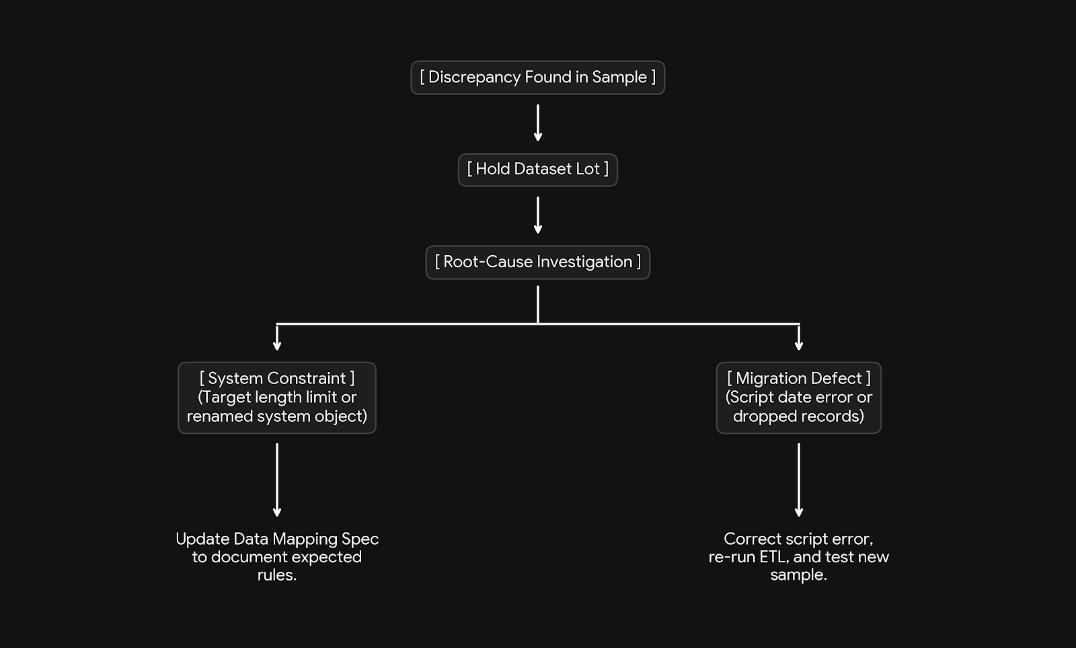
- System Mapping Constraints: Schema mismatches (e.g., target field length limits) require updating the master Data Mapping Specification to document expected transformation logic.
- ETL Migration Defects: Code execution errors require correcting the transformation script, re-running the data pipeline lot, and drawing a new random sample for re-testing.
Regulatory inspectors may evaluate the quality of defect logging, root-cause analysis, and controlled re-testing rather than claims of an unverified, error-free run.
Additionally, data verification strategies should accommodate operational priorities. For instance, when active clinical trials require immediate site communication capabilities (such as escalating urgent safety alerts), critical study objects can be provisioned in advance while bulk records undergo automated migration. This strategy maintains data integrity without delaying clinical operations.
A Repeatable Blueprint for Compliant Migrations
Replacing traditional factory sampling heuristics (n+1, ANSI Z1.4) with object-level risk assessments, qualified transformation tools, and Zero-Acceptance Sampling (c=0) enables organizations to ensure data integrity and most importantly protect and limit the consumer risk (risks to the patient). A compliant migration delivers a defensible dataset and validated evidence ready for regulatory inspection.
Preparing for an eTMF or enterprise GxP data migration? Contact ERA Sciences today to benchmark your migration strategy and implement a risk-proportionate c=0 sampling protocol.